Why Your Practice Score Differs from Your Mock Score
Practice and Mock Are Two Different Tools
Many students notice their practice scores run higher than their mock exam scores on ClearMyPTE. This is not a bug — the two products are calibrated differently because they answer different questions.
Why Practice Scores Are More Lenient
Practice mode is designed to encourage repetition and skill development. The AI applies a small institute-configurable leniency factor on top of base PTE scoring, and the visible score is rounded up at item level. The goal is fast, motivating feedback so students keep practising — not a real-world prediction.
- Item-level scoring with sub-skill breakdowns (pronunciation x.y, fluency x.y, content x.y).
- Institute leniency factor (typically 1.00–1.15) applied per question type.
- Per-question instant feedback, no time pressure across a full test.
Why Mock Scores Hew Closer to Real PTE
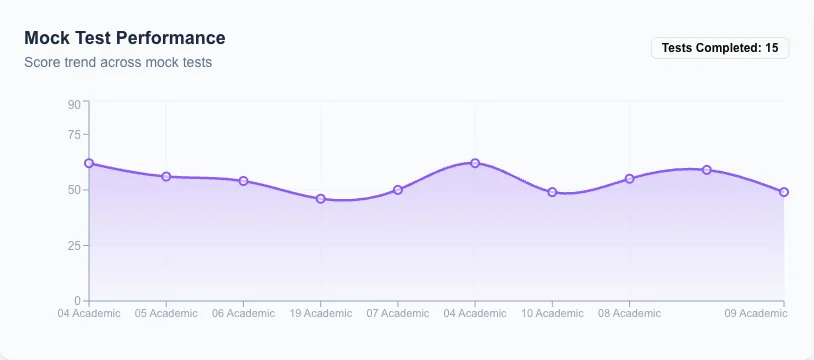
Mock exams use the real PTE scoring model with no leniency factor. They reproduce Pearson's weighting, the cross-skill aggregation, and the holistic 0–90 calculation. They also reproduce real test fatigue: 2 hours back-to-back with no instant feedback.
- Full-length, timed, locked navigation.
- Holistic 0–90 overall + four communicative + six enabling skills.
- No item-level leniency.
Don't Anchor Decisions on Practice Alone
If you are deciding whether to book the real PTE, use mock scores, not practice scores. A practice score of 75 might correspond to a real-test 65 — booking the real exam on a 75 practice number is the most common reason students under-perform on test day.
Recommended Workflow
- Use practice mode daily to drill weak question types and watch sub-skill numbers move.
- Take a full mock exam every 7–14 days for a calibrated reading.
- Only book real PTE when your mock score sits 5+ points above your visa target for two mocks in a row.
Read more on what a mock exam is and how the predicted PTE score is calculated. Track both numbers from your dashboard.